
Poor indoor mobile connectivity could be costing the UK economy £103 billion a year, according to senior decision-makers surveyed by Freshwave with public sector respondents estimating £63 billion of this impact falls on their sector. This highlights a clear opportunity for business and government to bolster national productivity.
This is according to connectivity infrastructure-as-a-service provider Freshwave’s 2026 Mobile Connectivity ROI Index, an annual survey of 900 C-suite and IT decision-makers from multiple industries across the UK’s private and public sectors. Senior leaders share their views on indoor mobile connectivity and the potential gains that can be achieved from investing in improving it – both financially and operationally.
The 2026 survey shows that senior leaders believe that improved indoor connectivity can immediately recover more than £60bn of the UK-wide losses each year, including £39bn across the public sector. Across most industries, respondents pointed to real-time, continuous data as the biggest opportunity to drive efficiency gains and accelerate digital transformation. Examples of the real-time capabilities highlighted by respondents include enhanced passenger flow monitoring at rail stations, connected devices in community care, intelligent surveillance in commercial real estate and tracking of progress on construction sites.
AI is becoming increasingly pivotal to these applications which all depend upon continuous, uninterrupted signal to work effectively. A London chief operating officer described “proper integration of AI into automation and analytical processes” as a challenge they’re currently facing due to poor indoor connectivity, while a London chief information officer cited “security and limited scalability for future growth” as concerns.
The clear need to improve the UK’s indoor connectivity infrastructure coincides with rapid adoption of AI tools by individuals and organisations, and the new Government’s ambition to put AI at the centre of its plans for economic growth and public-sector efficiency. Kanishka Narayan was recently appointed the UK’s first ever Minister of State for AI.
Simon Frumkin, CEO of Freshwave, commented: “AI presents one of the greatest opportunities we have to grow the economy, and the efficiencies it promises rest on the connectivity underpinning many of its functions. Treating indoor mobile coverage as essential infrastructure is what turns that opportunity into results.
“We hope the new AI minister will look to improved indoor coverage as a priority for boosting the economy, particularly across a public sector estate that could stand to gain £39 billion a year.
“Mobile operators invest heavily, but they have to be selective about where they go indoors, which leaves most of that estate with mobile “not-spots” inside buildings. The right indoor mobile infrastructure solution exists today, it extends the operators’ networks where it’s needed, and the payback is immediate.”
Leaders in nearly nine in ten organisations (89%) report daily indoor connectivity problems, and more than 40% believe a one-hour outage would cause major disruption or stop operations altogether. The problem originates in the buildings themselves, where energy-efficient glazing and insulation keep heating bills down but mobile signal out, leaving staff without reliable service indoors.
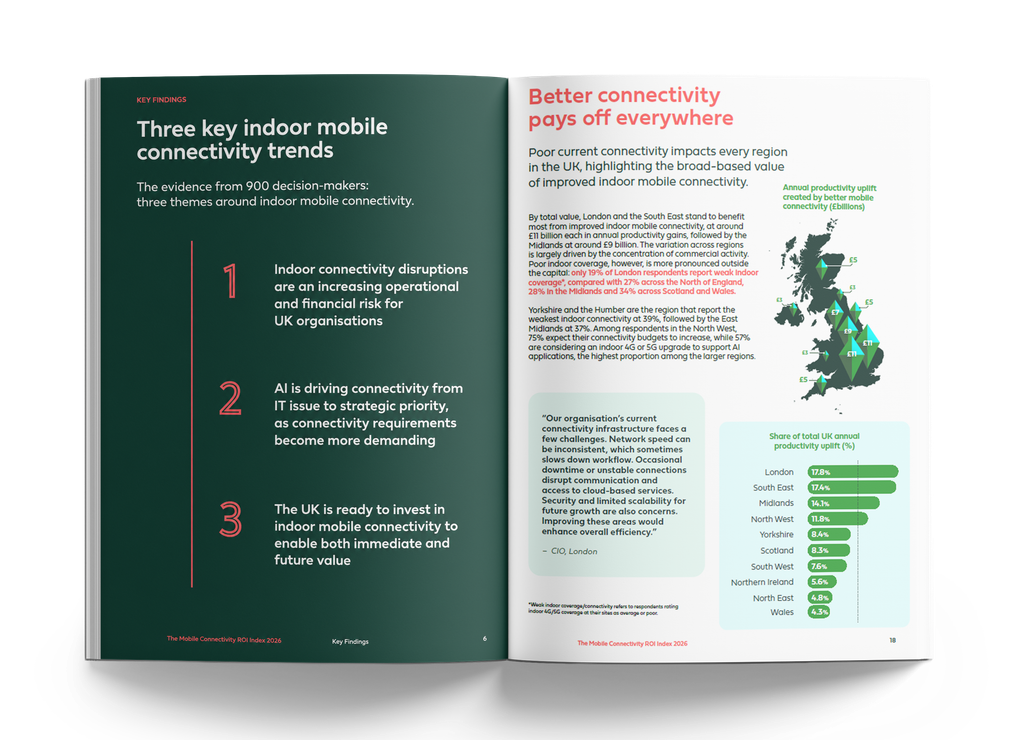
Across the UK, around 23% of organisational leaders rate their indoor 4G or 5G coverage as average or poor. In London the figure is 19%, but it rises to 27% across the North of England, 28% in the Midlands and 34% across Scotland and Wales. The widest regional gaps are in Yorkshire and the Humber at 39% and the East Midlands at 37%. The survey indicates that the problem is not spread evenly, positioning poor indoor mobile coverage as part of the regional infrastructure gap that the Government is looking to close through increased devolution.
Organisational leaders say they are ready to act. Seven in ten expect their indoor connectivity budget to grow over the next two years. This is most prominent in the North West, where three quarters of organisations expect connectivity budgets to rise, and 57% are weighing an indoor 4G or 5G upgrade to support AI applications – the highest proportion among the larger regions.
Simon added: “Devolution is about giving regions outside of London the tools to grow. Indoor mobile coverage should be top of that list. Regions outside of London have the most to gain, and the North West is already showing the appetite for it. Indoor connectivity is essential now, in the same bracket as power and water. AI is simply making that increasingly impossible to ignore.”
Download the report here.
Research methodology
The survey posed several questions for organisations across the UK from nine different sectors (100 organisations with greater than 100 employees) including the impact of existing connectivity issues on their business. The survey also asked them how much of this impact could be mitigated through improved mobile connectivity. This enabled the calculation of the average loss and mitigation value for businesses of different sizes within each sector across different regions of the UK. These average values were then used and applied to all relevant businesses across the UK – those with greater than 100 employees, within the target vertical industries, within each region. This enabled the calculation of the impact on specific industries, specific company sizes, and specific regions.
The research pool consisted of 900 senior executives from medium and large organisations across the UK’s private and public sectors. All respondents represented organisations with over 100 employees and annual revenues or budgets exceeding £50 million. Industries represented were: commercial real estate (developers); professional and financial services; healthcare (acute care centres); commercial real estate (landlords); venues, stadiums and arenas; healthcare (community care centres); rail stations; higher education; and government and public sector.
Freshwave first launched the Mobile Connectivity ROI Index in 2025 and runs it annually, with 2026 marking the second year of the research.